
Estimation of Subsurface Thermal Conductivity from the Ground to the Laboratory: A Geothermal Case Study in Slovenia
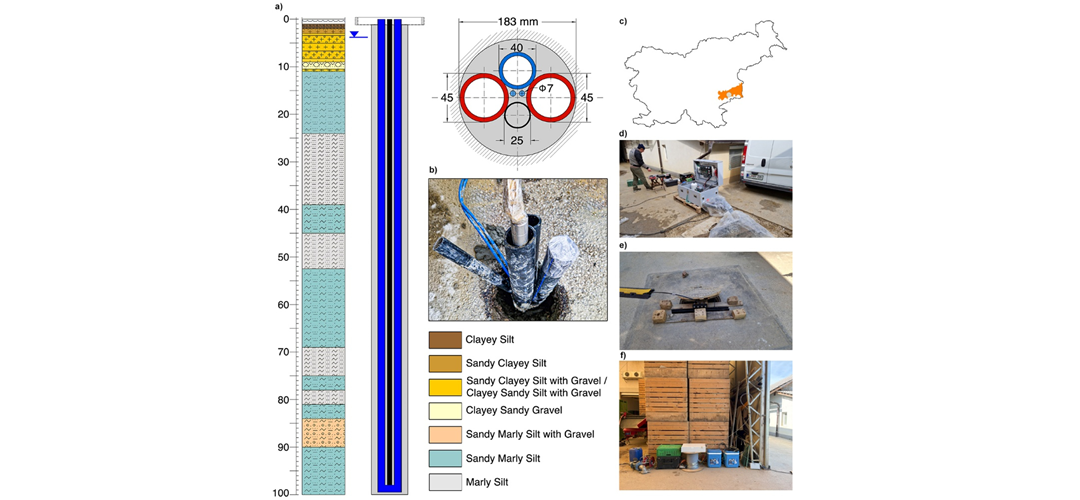
We, the researchers at GeoZS, used advanced fiber-optic technologies (DTS) for the first time in Slovenia for geothermal research near Krško. In the 100-meter-deep GCF-1/24 exploration well, drilled as part of the GeoCOOL FOOD CRP project, we compared various laboratory and field methods for determining the thermal conductivity of rocks and sediments. Thermal conductivity, along with the presence of groundwater, is a key parameter for the optimal design of shallow subsurface utilization systems using geothermal heat pumps.
The results showed that traditional laboratory measurements using needle probes often underestimate the thermal conductivity of soil, whereas measurements using the TCS thermal scanner in the laboratory and advanced field tests with optical fibers yielded more comparable and reliable results. Optical-fiber technology has made it possible to identify depth-dependent variations in sediment properties and to detect the influence of groundwater on heat transfer.
The study's findings contribute to better planning of shallow geothermal systems and confirm the importance of selecting an appropriate measurement method when assessing geothermal potential. The study was published in a leading international scientific journal for geothermal research. Geothermics.
Adapted from the article: Karlo Borko, Fiona M. Chapman, Jasmin Raymond, Grzegorz Ryżyński, Nina Rman, “Field to Laboratory Assessment of Subsurface Thermal Conductivity: A Geothermal Case Study in Slovenia,” *Geothermics*, Volume 141, 2026, 103747, ISSN 0375-6505, https://doi.org/10.1016/j.geothermics.2026.103747.