
Identification of the mineral dynamics within the bog as reflected in the composition of the water
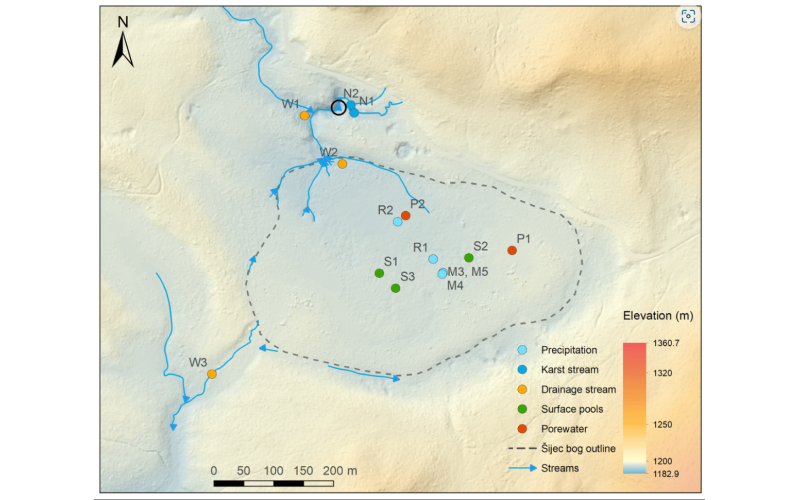
The hydrology of bogs plays an important role in maintaining or changing the record of past atmospheric deposition in bogs. The Šijec bog, located on the Pokljuka plateau, is one of the largest ombrotrophic bogs (receiving water and mineral matter only from the atmosphere) in Slovenia. We sampled surface pools, pore water, drainage from the bog and karst streams not connected to the bog. In addition, we sampled precipitation, as ombrotrophic bogs receive mineral matter exclusively from the atmosphere. The results of the chemical and isotopic composition showed different sources of dissolved mineral matter in the different water types. In the streams, components originating from the bedrock and surrounding soils (calcium, magnesium, aluminium, silicon, strontium) predominated. The chemical composition of the bog drainage water revealed a significant removal of the main components from the bog, in particular elements such as aluminium, iron and rare earths, and metals that are more easily dissolved in acidic environments or mobile in a reducing state. The pore water composition reflects the differences between the western and eastern parts of the bog, indicating a heterogeneous hydrological structure with different dynamics. In the north-western part of the bog, an additional water source is present at a depth of approximately 90 cm. The overall analysis shows a predominantly ombrotrophic bog type, with a small part in the north-western part where a minerotrophic bog type is present (receiving water and mineral matter also from other sources such as groundwater and surface inflow).
Taken from the article:
PEZDIR, Valentina, SERIANZ, Luka, GOSAR, Mateja. Evaluating mineral matter dynamics within the peatland as reflected in water composition. Sustainability. 2024, vol. 16, no. 11, 24 p. ISSN 2071-1050. DOI: 10.3390/su16114857. [COBISS.SI-ID 198254595]