
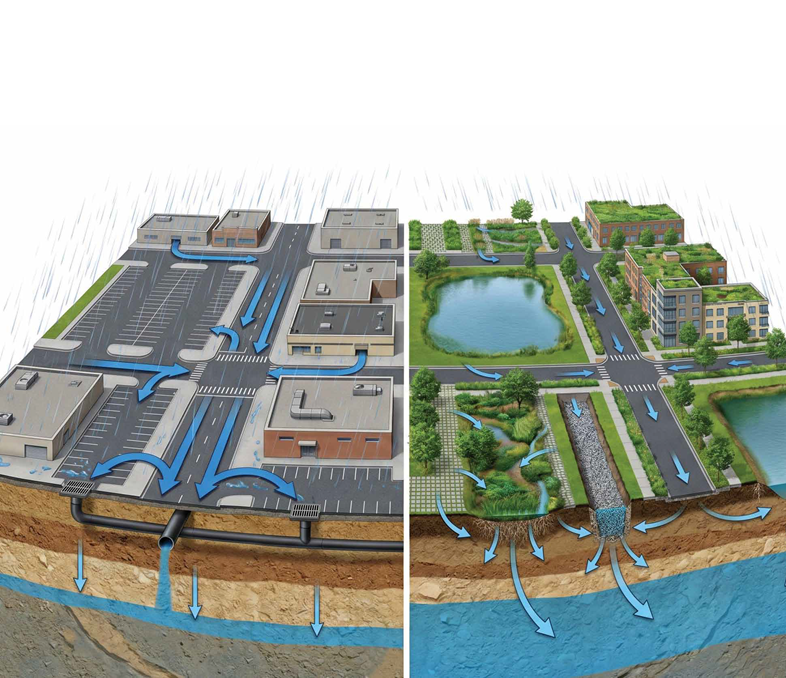
THE WATER CYCLE IN CITIES
In nature, stormwater mostly seeps into the ground and becomes part of the water cycle. In towns and cities, however, impervious surfaces (roads, car parks, roofs) interrupt this process. When planning spatial interventions, it is possible to design layouts that reduce the extent of sealed surfaces, while ensuring that a large proportion of these surfaces remains uncontaminated. It is easier to ensure the infiltration of clean water than of polluted water. The drainage of stormwater through retention-infiltration basins and infiltration trenches can ensure that at least 80% of stormwater is returned to the water cycle in soils with moderate to low permeability.
EXAMPLES OF BLUE-GREEN INFRASTRUCTURE
Retention and infiltration fields
The facility consists of both an underground and a surface component. The above-ground section is designed as a shallow grassy depression, while the underground section allows water to gradually seep into the subsoil.
Rain gardens and green basins
Shallow depressions with permeable soil and vegetation that slow surface runoff, purify the water, and help improve the local microclimate.
Permeable surfaces
Perforated paving slabs, geogrids, mixtures of stone and soil, and permeable asphalt, which improve conditions for water infiltration and retention.

TEST RETENTION AND INFILTRATION FIELD AT TIVOLI SWIMMING POOL IN LJUBLJANA
As part of the MAURICE project (Interreg Central Europe programme), we worked with our partner JP VOKA SNAGA to construct a pilot retention and infiltration field at Tivoli Swimming Pool in Ljubljana. The field collects stormwater from the car park, access roads and grassed areas (a total area of 1,064 m²), where it gradually infiltrates into the subsurface.
How does it work?
The water first flows through a pretreatment unit, which acts as both a sedimentation tank and an oil separator. Water then enters the underground section, consisting of layers of a mixture of humus and sand, gravel, and a mixture of zeolite and sand, arranged in that order from top to bottom, with protective polypropylene layers in between. During very heavy rain, water briefly fills a shallow grassy depression on the surface, which drains away within a few hours. The retention and infiltration field allows infiltration of 0.33 litres of water per second and provides a total storage volume of 44 m3 . The structure is designed to withstand heavy rain with an intensity of 317 litres per second per hectare and a duration of 20 minutes, which occurs on average once every 50 years.
What are we measuring?
At the test site, we monitor precipitation, inflow and outflow volumes, water quality, and changes in infiltration capacity over time, even in soils with lower permeability.
WHY IS PLANNING OF BLUE-GREEN INFRASTRUCTURE IMPORTANT?
The results of these studies help in the design of new infiltration systems, even in areas with lower permeability in Ljubljana and throughout Europe, which brings numerous benefits.
- Improved groundwater recharge – the Ljubljansko polje is the most important source of drinking water for Ljubljana; every litre of clean stormwater that infiltrates into the ground rather than entering the sewer system contributes to its recharge.
- Reduced strain on the sewerage system during heavy downpours.
- Preservation of natural springs.
- Reduced drying out of soils.
The planning and implementation of blue-green infrastructure solutions is a joint endeavour involving geologists, hydrogeologists, hydraulic engineers, urban planners and city residents. It brings together research institutions, urban space managers and local communities with a single aim: to increase the resilience of urban areas to climate change.
Authors: Simona Pestotnik, mag. Joerg Prestor