
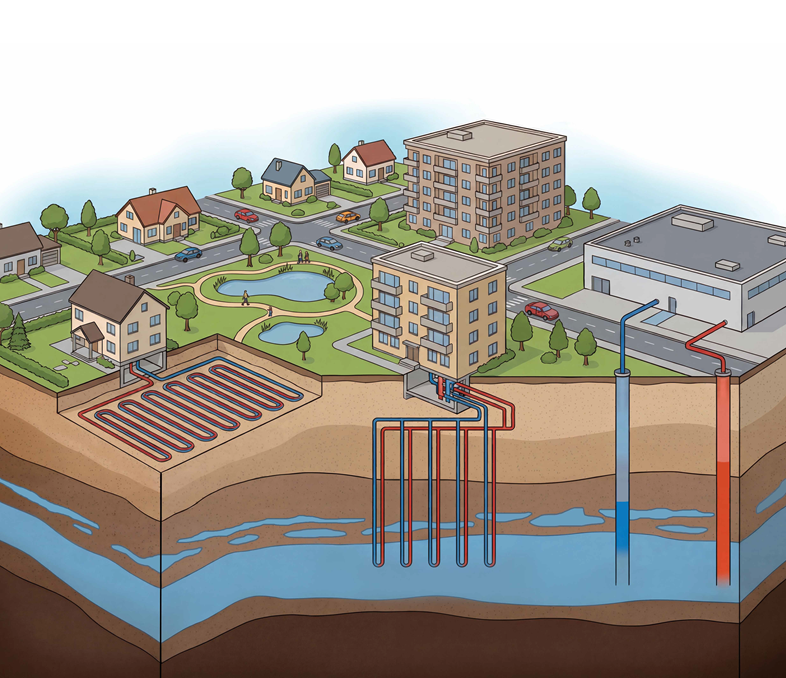
HOW DO WE CAPTURE IT?
Closed systems ‒ horizontal collectors and vertical geothermal probes
Closed systems with horizontal collectors or vertical geothermal probes do not require groundwater, although its presence significantly increases the system’s capacity.
Open systems ‒ boreholes and wells
We extract heat from groundwater (for heating) or add heat to it (for cooling). We need a sufficient quantity of water in the aquifer, which we return through a second borehole after use.
WHAT ARE WE RESEARCHING?
The feasibility and capacity of shallow geothermal energy systems depend primarily on the geology and the presence of groundwater. We use geothermal and hydrogeological exploration techniques to determine:
- potential for using shallow geothermal energy for heating and cooling buildings,
- how the thermal conductivity, thermal resistance and thermal diffusivity of the ground affect its ability to conduct or store heat underground,
- the impact of groundwater on the capacity and efficiency of ground heat exchangers, and
- the impact of utilisation on changes in subsurface temperature, ecosystems, and the mobilisation of pollutants in soil and groundwater.
WHAT RESEARCH METHODS AND EQUIPMENT DO WE USE?
Thermal Response Test
Determination of the effective thermal conductivity of the subsurface along a ground heat exchanger.

Thermal Response Test
The continuous, high-resolution determination of subsurface thermal conductivities along a ground heat exchanger, and identification of zones with groundwater flow that enhances the system’s performance.
THE IMPACT OF URBAN AREAS ON THE USE OF SHALLOW GEOTHERMAL ENERGY
The ground temperature beneath urbanised areas is a few degrees higher than in the surrounding areas, leading to the urban heat island effect. The higher density of buildings and paved surfaces severely restricts the infiltration of rainfall. In addition, underground infrastructure, such as underground car parks, cellars and sewers, emits waste heat. Shallow geothermal energy can be used for heating and cooling, and its use can be planned to mitigate the subsurface urban heat island effect.
WHY IS OUR RESEARCH IMPORTANT?
- Data on the effective thermal conductivity of the ground enables accurate sizing of new shallow geothermal energy systems.
- Given the funds available for the investment, we can make the best possible use of natural resources, prevent undesirable impacts on neighbouring systems, and minimise the long-term impact on the subsurface and the environment.
- Simulating the impacts of existing and planned geothermal users forms the basis for rational and sustainable use, particularly where groundwater is used in open systems.
- Publicly available geothermal data enables future investors to implement new systems more quickly and at lower cost.
Suitability for borehole heat exchangers use in Ljubljana (results of the GeoPLASMA-CE project)
Authors: doc. dr. Nina Rman, dr. Mitja Janža, dr. Simona Adrinek, Karlo Borko