
New Doctors of Science – Dr. Barbara Čeplak
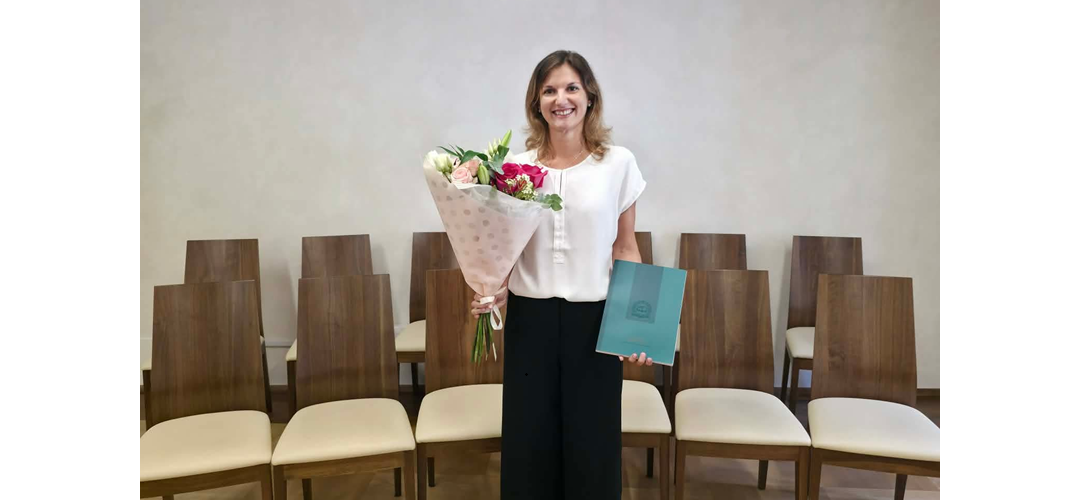
On September 2, 2026, Dr. Barbara Čeplak successfully defended her doctoral dissertation titled Distribution of major and trace elements in the sediments of the Mura River with a focus on technologically critical elements. She conducted her doctoral research under the supervision of Assoc. Prof. Gorazd Žibret, Ph.D., of GeoZS.
The purpose of this doctoral dissertation was to determine the relationship between the bedrock, past and present human activities, and the mineralogical and elemental composition of sediments in the Mura River. Particular attention was paid to the presence of technologically critical elements (TCEs), whose concentration in the environment is believed to be increasing year by year with the development of high-tech industry. The determination of the elemental and mineralogical composition of the sediments and the identification of characteristic carriers of specific elements were performed using three analytical methods: scanning electron microscopy with energy-dispersive spectroscopy (SEM/EDS), inductively coupled plasma mass spectrometry (ICP-MS), and X-ray powder diffraction (XRD). Using multivariate statistical methods, geogenic, anthropogenic, and geogenic-anthropogenic geochemical assemblages were identified. Significant elemental and mineralogical differences were found between the upper, middle, and lower reaches of the Mura River. The study showed that the elemental composition of sediments in the tributaries better reflects the influences of local geology and anthropogenic activities than the sediments of the main channel. The elemental composition of riverbed sediments and alluvial sediments primarily reflects the natural distribution of elements, with no detectable anthropogenic enrichment in TCE (YREE, Nb, Ta, Te, Tl, In, Sb, and Ga). In contrast, suspended sediments serve as more sensitive indicators of anthropogenic impacts in the river environment, including those associated with the development of modern technologies. The study contributes to a better understanding of the role of TCE as potential new environmental pollutants, while also addressing the dynamics of existing pollutants. The results are important for water management authorities and support sustainable land use and the protection of water resources.
The doctoral dissertation is available at here.
We are also including links to two scientific publications: