
Field Trip for Students at Geotabor 2026 in Bela Krajina, July 14, 2026
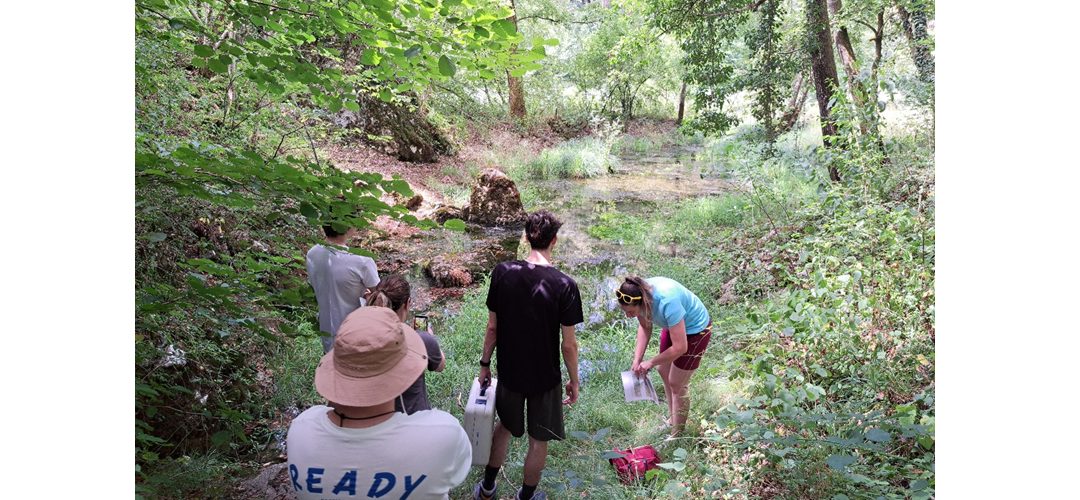
Where in the Bela Krajina region does drinking water originate? Why is the karst aquifer so vulnerable to pollution? What role does groundwater play in the conservation of endangered species, such as the olm?
Geology students, who participated in a field trip as part of Geotabor 2026 in the Bela Krajina region led by Katja Koren Pepelnik of GeoZS, sought and found answers to these questions. Part of the field trip was dedicated to presenting the impacts of human activities on groundwater, including monitoring industrial areas and the story of the karst spring of the Krupa River, which, due to historical PCB contamination, is one of the best-known examples of the long-term impact of industry on the karst environment in Slovenia.
The participants visited the most important hydrogeological sites, including the Dobličica spring, which supplies drinking water to most of the Bela Krajina region. Bojan Klemenčič from Komunala Črnomelj presented the characteristics of the Dobličica spring and the Dobliče pumping station. The Dobličica spring is also an important habitat for the olm, whose survival is closely linked to the high quality of the groundwater. The students learned about field measurements of temperature, pH, electrical conductivity, and oxygen content, and then conducted the measurements themselves at the Topličica subtermal spring. The excursion continued to the Pod lipo, Lahinja, and Okno springs and concluded at the Sinjevrški pond, which has dried up.